 Purple Sector
Optimal lap time (theoretical best lap), explained
An optimal lap adds your quickest time through each sector, from any lap. How Race Studio 3, RaceBox, VBOX and others work it out, and where it misleads.
A theoretical best lap is the sum of your quickest time through each sector of the track, taken from any lap in the session. AiM calls it the best theoretical lap, RaceBox the theoretical best lap, VBOX the ideal lap and RaceChrono the optimal lap. It shows what your best pieces add up to, not a lap you’ve driven.
Purple Sector has no commercial relationship with any brand on this page.
How it’s worked out
- Split the lap into sectors.
- For each sector, take your quickest time through it from any lap.
- Add those times together.
An example (made-up numbers): a lap split into three sectors.
| Sector | Lap 4 | Lap 7 | Lap 9 | Quickest |
|---|---|---|---|---|
| 1 | 21.40 | 21.18 | 21.32 | 21.18 (lap 7) |
| 2 | 18.62 | 18.90 | 18.71 | 18.62 (lap 4) |
| 3 | 19.25 | 19.30 | 19.08 | 19.08 (lap 9) |
| Lap time | 59.27 | 59.38 | 59.11 | 58.88 theoretical best |
The best lap driven is lap 9, 59.11. The theoretical best, 58.88, is 0.23 s quicker, built from three different laps.
What each tool calls it
Checked 23 October 2026 on each vendor’s own pages.
| Tool | Name | How the vendor describes it |
|---|---|---|
| AiM Race Studio 3 | Best theoretical | “Obtained summing all best split times of all considered laps.” It also shows a best rolling lap: the quickest continuous lap-length run actually driven. |
| AiM RaceStudio 3 app | Best theoretical | Its split report shows best theoretical and rolling laps. |
| RaceBox app | Theoretical best lap | “The sum of the best sector times for each sector on the track.” Custom tracks take up to 4 splits. |
| VBOX Circuit Tools 2 | Ideal lap | Built from the fastest sectors of all laps. Splits are placed automatically at the points of maximum speed. |
| RaceChrono | Optimal lap | Lap timing with sectors and optimal lap. Its developer calls it the theoretic best you can reach with your current driving. |
| TrackAddict | Theoretical lap time | Listed with sector split timing, in circuit mode. |
| Harry’s LapTimer | Virtual best | Listed with best sector analysis. |
| Pushlapp | Theoretical best lap | Built from your own fastest sectors. |
| PURPL | Ideal lap | Stitched from your fastest sectors. |
| Garmin Catalyst | True Optimal Lap | A video that splices together your best achievable time; Garmin says it’s based on the lines you drove and is meant to be drivable. |
| Formula 1 timing | Ideal lap | Each driver’s quickest mini-sector times from a session, added together. |
| Purple Sector | Optimal lap | Your quickest run from each corner to the next, joined into one lap. |
Why the number depends on the sectors
- More sectors, lower number. Splitting a sector in two can only keep the sum the same or make it smaller, because each half can now come from a different lap. A theoretical best from many small sectors is more optimistic than one from three.
- Where the splits sit matters. A sector that ends mid-corner can pair a fast entry from one lap with a fast exit from another that never happened together. Racelogic places VBOX splits at the points of maximum speed so each sector holds a whole corner, slowing down and accelerating out.
- Sectors depend on each other. A quicker sector is sometimes bought with a slower exit into the next one. Garmin’s Catalyst blog makes the same point: the drivable lap can mean slowing slightly in one segment to gain more in the next.
How to use it
- The gap is a consistency measure. The difference between your best lap and your theoretical best shows how much of your own pace you haven’t put into one lap yet. A small gap means you’re consistent and the next step is finding new pace; a big gap means the pace is there in pieces.
- Find the sector that’s furthest from its best on your typical laps. That’s the part of the lap to work on first, not the one where your single best was set.
- Compare like with like. Only add sectors from the same layout, direction and conditions. Two sessions on different tyres or in the wet and the dry don’t make one lap.
- Don’t treat it as a target lap time. It’s a ceiling on what one session contained, not a prediction.
Purple Sector’s optimal lap
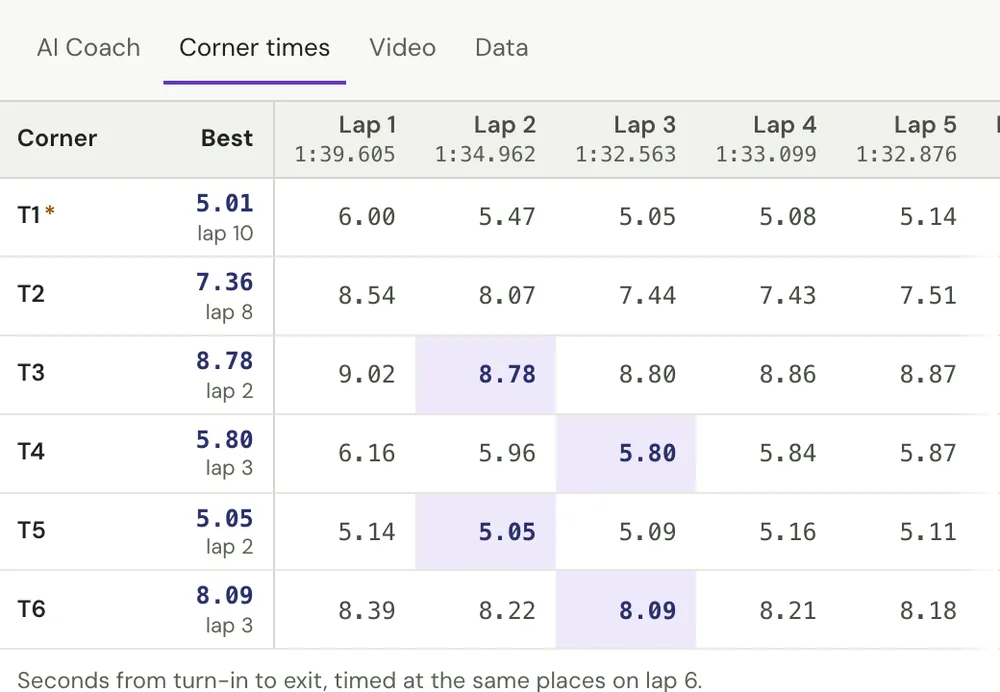
Open a session with two or more laps and the optimal lap appears above the charts, with its gap to your best lap. Each stretch runs from one corner to the next, so every piece holds a whole corner. Hover it to see which laps each piece came from. On a phone it’s under Session tools. It isn’t shown when laps in the file run in different directions or on different routes. The Corner times tab lists every corner on every lap with the quickest marked.

Questions
What is a theoretical best lap?
The sum of your quickest time through each sector of the track, taken from any lap in the session. It shows what your best pieces add up to.
Is the theoretical best lap achievable?
Not always in one lap. Sectors depend on each other, and a quick sector can come with a slower exit into the next. RaceChrono’s developer calls the optimal lap theoretic and points to the best rolling lap as the realistic figure.
What’s the difference between a theoretical best and a best rolling lap?
A theoretical best adds sector times from different laps. A best rolling lap is the quickest continuous run of one lap’s length you actually drove, which can start and end anywhere on the lap. AiM describes it as the best lap time really made, even if its splits belong to different laps.
How does Race Studio 3 work out the theoretical best lap?
AiM’s manual says it sums all the best split times of all the laps considered. Adding splits in Race Studio 3 changes the sectors, so the figure can change too.
What is a good gap between my best lap and my theoretical best?
There’s no fixed number: it depends on the track, the number of sectors and how they’re placed. Track your own gap from session to session with the same sectors; a shrinking gap means you’re putting more of your pace into one lap.
More: How to read MyChron data · How to compare laps · Track day telemetry for beginners · Garmin Catalyst vs RaceBox vs AiM Solo 2 · Lap timer apps compared · Race Studio 3 on a Mac
Sources, checked 23 October 2026
- AiM: best theoretical lap sums all best split times of all considered laps; best rolling is the best lap really made even if its splits belong to different laps; splits added with "+": aim-sportline.com/docs/racestudio3/manual/html/analysis.html
- RaceBox: theoretical best lap is the sum of the best sector times; custom tracks take up to 4 splits: racebox.pro/info/racebox-user-manual/lap-timer
- VBOX Circuit Tools 2: ideal lap from the fastest sectors of all laps; splits at the points of maximum speed: en.racelogic.support/motorsport/discontinued-legacy/software/circuit-t
- RaceChrono: lap timing with sectors and optimal lap: racechrono.com
- RaceChrono’s developer: the optimal lap is the theoretic best with your current driving; the best rolling lap is the realistic figure: racechrono.com/forum/d/2132-2132
- RaceStudio 3 app: split report with best theoretical and rolling laps: apps.apple.com/au/app/racestudio-3/id6443408349
- Pushlapp: theoretical best built from your own fastest sectors: apps.apple.com/au/app/id6789864725
- PURPL: the ideal lap stitched from your fastest sectors: purpl.app/features
- TrackAddict: sector split timing and theoretical lap time in circuit mode: apps.apple.com/us/app/trackaddict/id490135959
- Harry’s LapTimer: best sector analysis and virtual best: forum.gps-laptimer.de/viewtopic.php?t=3720
- Garmin: True Optimal Lap splices a driver’s best achievable time into one video, based on the lines driven: garmin.com/en-AU/blog/optimise-time-on-the-track-with-the-cutting-edge
- Garmin: the best drivable time; slowing a bit in one segment to gain more in another: garmin.com/en-GB/blog/?p=7398
- Formula 1 ideal lap: a driver’s quickest loop times from a session, added together: formula1.com/en/latest/article.ideal-lap-bottas-quickest-but-returning
- The gap between fastest and ideal lap is the consistency gap: aimshop.com/blogs/driver-tips/how-to-read-and-improve-your-lap-times-w
- Purple Sector’s optimal lap: quickest from each corner to the next, needs two or more laps, not shown with mixed directions or routes; Corner times tab marks the quickest: purplesector.dev/analyse/sample